
ERP in one sentence
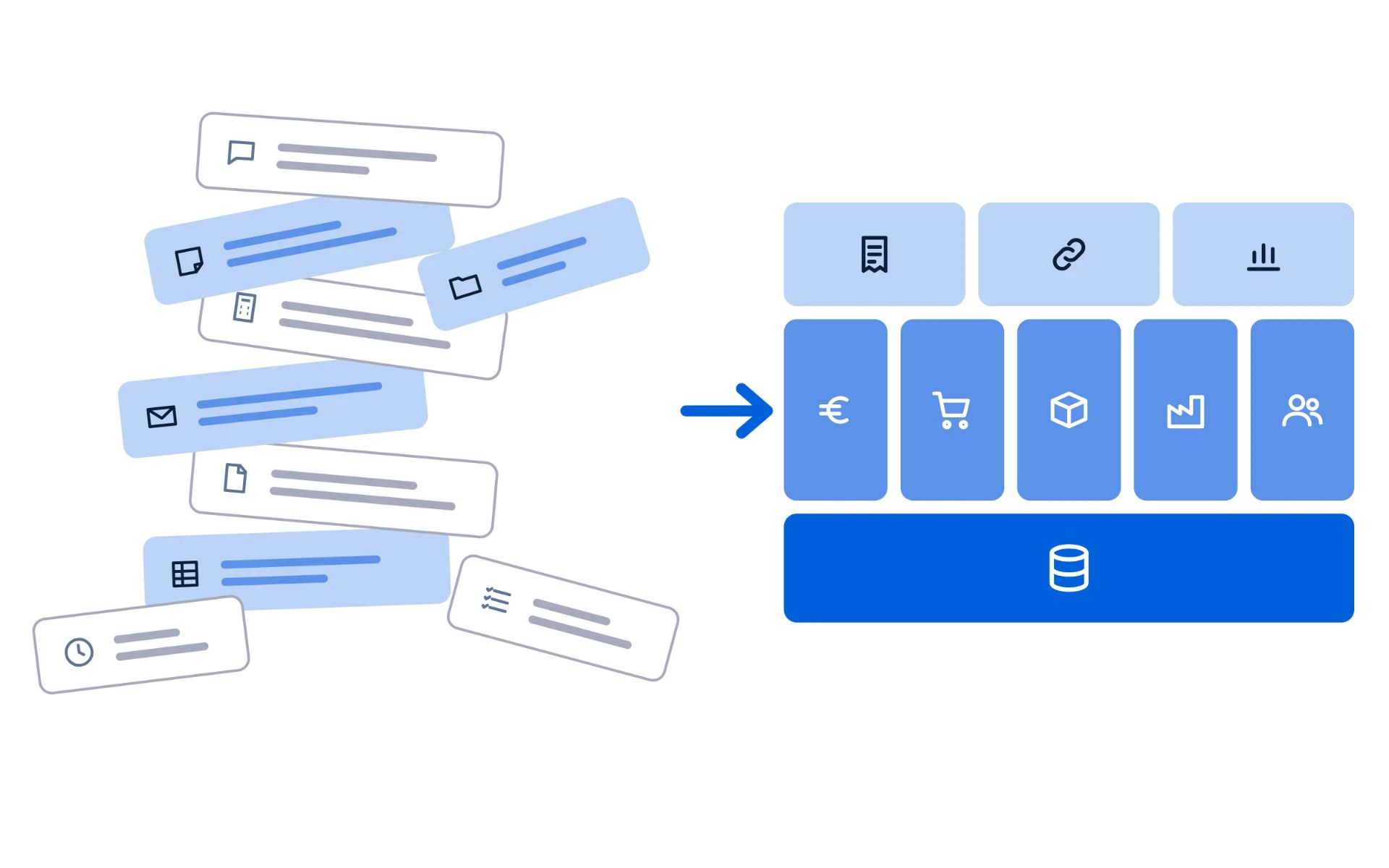
ERP stands for enterprise resource planning. It brings your core processes together on one platform, with one shared database underneath: a single source of truth for finance, operations, projects and reporting.
Most growing companies know the alternative well. An accounting package here, a CRM there, a warehouse spreadsheet somewhere in between. Every hand-off means copying data, and every copy is a chance for errors. Stacking more tools rarely fixes that.
An ERP platform replaces that patchwork with one foundation. Teams record a transaction once, workflows run automatically, and reports reflect what is happening right now, not what happened last month.
How an ERP system works
An ERP system is a set of connected modules that all read from and write to the same database. Each module covers one business area, but none of them works in isolation.
Picture a customer order. Sales enters it once. Inventory reserves the stock, purchasing sees what needs reordering, the warehouse ships it, and finance invoices it and books the revenue. Nobody retypes a thing.
Three building blocks make that possible:
- A shared database. One version of every customer, item, supplier and account, used by every team.
- Modular design. Start with the modules that deliver the most value and add more as you grow, without a big bang.
- Open integration. Through APIs and connectors, ERP links to the tools that already work for you, such as your CRM, e-commerce platform or industry software.
What ERP does for each part of your business
ERP earns its value where departments meet. Here is what that looks like in five core areas, all running on the same shared foundation.
- General ledger
- Accounts receivable
- Accounts payable
- Bank reconciliation
- Fixed assets
- Budgeting
- Financial consolidation
- Multi-currency & VAT
- Leads & opportunities
- Quotes
- Sales orders
- Customer invoicing
- Subscriptions
- E-commerce
- Point of sale
- Returns
- Vendor management
- Purchase orders
- Approval workflows
- Warehouse picking & put-away
- Lot & serial tracking
- Stock transfers
- Replenishment planning
- Landed cost
- Bill of materials
- Routings & work centers
- Production orders
- Capacity planning
- Subcontracting
- Material requirements planning
- Production costing
- Quality control
- Project budgeting
- Task management
- Resource planning
- Timesheets
- Project invoicing
- Field service
- Expenses
- HR & payroll
Finance
Finance is the heart of every ERP system. Accounts payable and receivable, the general ledger, bank reconciliation and VAT all run on the same data as the rest of the business.
Because every sale, purchase and hour worked flows straight into the books, closing the month gets faster. Cash-flow forecasts become more reliable, audits become easier, and management sees real-time figures instead of waiting for a spreadsheet.
Sales & CRM
ERP and CRM are two sides of the same coin. CRM manages relationships, pipelines and campaigns; ERP handles quotes, orders, deliveries and invoices.
When the two are connected, your sales team sees stock levels, prices and payment history before they promise anything. Quote-to-cash becomes one continuous flow, and customers get faster, more accurate answers.
Purchasing & inventory
ERP standardises how you buy and gives you a live view of what you have. Purchase requests, approvals and orders follow one workflow, and supplier data lives in one place.
Inventory updates automatically with every receipt, sale and transfer. Reorder points and demand forecasts help you avoid both stockouts and overstock, while spend analysis shows where better supplier deals are waiting.
Manufacturing
For manufacturers, ERP connects the shop floor to the rest of the company. Bills of materials, production orders, capacity planning and quality checks all draw on the same item and stock data.
Planners see which materials are available and which machines are free. Costs are tracked per order, so you know what each product really costs to make and can deliver on time with fewer surprises.
Projects & people
Project-driven and service companies use ERP to plan work, assign resources and track time and expenses. Budgets, actuals and invoicing stay in sync, so project margins are visible while there is still time to steer.
On the people side, connected tools manage employee data, onboarding and workforce planning. That gives HR and management a clear picture of who is available, who is overbooked and where to hire next.
Why companies invest in ERP
The payoff of ERP is less manual work, better decisions and an organisation that scales without friction.
- Less double work. Data is entered once and reused everywhere, which cuts errors and frees people for higher-value tasks.
- Fast, reliable figures. Dashboards and reports show performance as it happens, so you spot risks and opportunities sooner.
- Lower operating costs. Fewer separate systems, fewer manual reconciliations and tighter control over stock and spending.
- Room to grow. Add users, entities, countries or modules without rebuilding your processes.
- Security and governance. Role-based access, audit trails and built-in controls make governance part of the daily routine.
- Better collaboration. Departments share one view of customers, orders and projects, so hand-offs stop being hold-ups.
Five signs you've outgrown your current tools
Many companies start with a simple accounting package and a few spreadsheets. That works, until it doesn't. Recognise any of these?
- You enter the same data twice. Orders, invoices or stock movements are retyped from one system into another.
- Your systems don't talk to each other. Your accounting software, CRM and warehouse tools each tell a different story.
- Reporting takes days. Closing the month or answering a simple question about margins means chasing spreadsheets.
- You lack real-time visibility. Decisions on stock, staffing or pricing feel like educated guesses.
- Growth is getting harder. A new entity, country or product line exposes how fragile your current set-up is.
If two or more sound familiar, it is time to take a serious look at your foundation.
Cloud ERP and AI: a future-ready architecture
Modern ERP runs in the cloud and increasingly thinks along with you.
With cloud ERP, the platform runs on the vendor's servers and you access it through the browser or a mobile app. There are no servers to maintain, updates arrive automatically, and your team can work securely from anywhere. Costs shift from large upfront investments to a predictable subscription.
AI is the next step. It already matches invoices, flags anomalies and forecasts demand. Built-in assistants let users ask questions in plain language and get answers straight from their business data. But AI is only as good as the data underneath it: a clean, structured foundation comes first.
How to implement ERP in six steps
A successful ERP project is a business project first and an IT project second. These six steps keep it on track.
- Define your needs and goals. Map where your current processes leak time and money, then set measurable goals and KPIs.
- Choose the right foundation. Weigh scalability, cloud options, AI capabilities, integration and total cost of ownership. Involve key users early through demos.
- Build a cross-functional team. Bring finance, operations, sales and IT to the table so every department shapes the system it will use.
- Roll out in phases and migrate your data. No big bang: start with high-impact areas, keep what already works and clean your data before you move it.
- Train, test and optimise. Show people how the system supports their daily work, test thoroughly and act on their feedback.
- Monitor and adapt. Track results against your KPIs and keep improving as your organisation evolves.
The right implementation partner makes every one of these steps faster and less risky.
Ready to find out where you stand?
You don't need to know every answer to take the first step. You only need to know where your current set-up holds you back.
Blue River is a Microsoft partner that builds the Business Central-backbone for growing companies, connected with Power BI and the Power Platform. We combine financial know-how with hands-on implementation, so your ERP fits the way your organisation actually runs.
Discover in a few minutes how ready your organisation is, or talk it through with one of our consultants.