
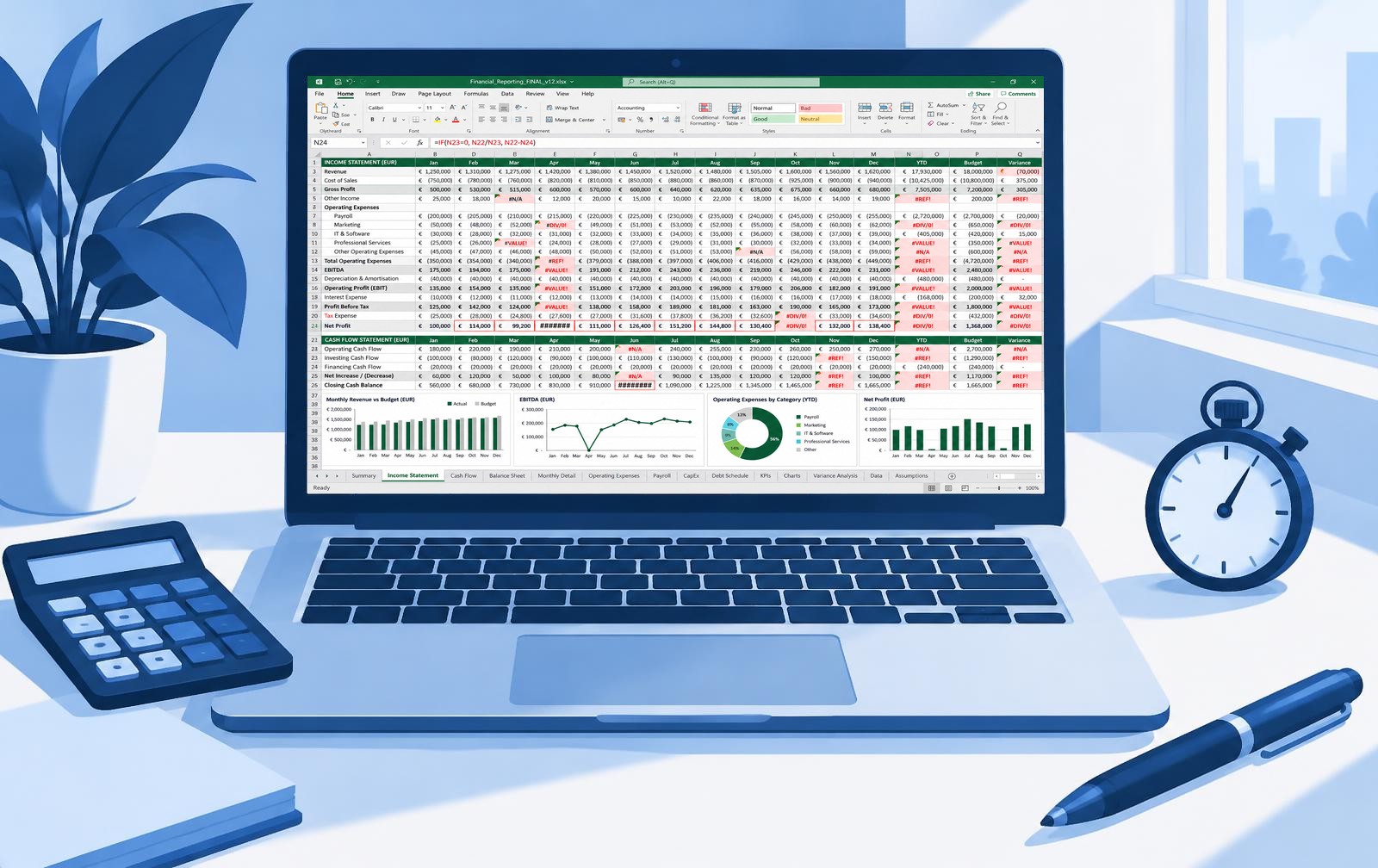
The same ritual every month. Pulling exports from the accounting package, merging files, retyping figures, linking accounts, updating formulas. Then, checking again if everything is correct. It happens so often that no one even considers how much time and money it consumes.
In our new whitepaper, The Cost of Manual Financial Reporting, we provide SME leaders and financial managers with a framework to calculate this. We don't promise a fixed saving and don't give an average amount. The framework helps you uncover your own figures.
Four Costs, Four Questions
1. Direct labor cost. How many hours do your people spend monthly producing reports? Multiply those hours by the full employer cost per hour. For external services, use the invoice cost.
Calculation example: 20 hours per month × €50 × 12 = €12,000 per year.
2. Cost of errors. Errors cost recovery time: searching, correcting, re-checking, and redistributing. Sometimes, consequential damages also follow, for example, when a decision is based on incorrect figures.
Calculation example: 3 extra recovery hours per month × €50 × 12 = €1,800 per year. Note: only add this to the labor cost if those three hours are not already included.
3. Cost of delay. Late figures only become a cost if they postpone a concrete action, such as a loss-making project continuing longer than necessary.
Calculation example: €300 avoidable loss per day × 10 days = €3,000 per incident.
4. Opportunity cost. What could your people do with that time? Analyze profitability per customer, monitor payment behavior, or develop scenarios. Twelve freed-up hours do not in themselves generate profit. However, a concrete analysis that fits within that capacity and is expected to yield €6,000 net per year can be assessed as a separate scenario.
Honest Calculation
Such a calculation can quickly become overly optimistic. Therefore, the whitepaper contains clear ground rules:
- Do not double-count. Include recovery hours once, and do not record the same consequential damage under both errors and delays.
- Keep capacity and expenses separate. The €13,800 in personnel input in our example is the value of time utilized. It is not an additional invoice and not automatically a saving.
- Do not blindly include missed value. The €6,000 opportunity cost is separate from the total.
- Also calculate the costs of improvement. Implementation, training, licenses, integrations, and maintenance belong in every business case.
Moreover, a faster report only yields delay benefits if your company also acts faster.
How Sensitive Is Your Figure?
The number of hours and the hourly rate determine a lot. At 20 hours per month and €40 per hour, you arrive at €9,600 per year. At 60 hours and €65 per hour, that's €46,800. Therefore, it makes little sense to copy an average. All amounts in our examples are deliberately fictitious and not a benchmark for Belgian SMEs.
Your Assignment for the Coming Weeks
The framework requires little preparation:
- Measure three consecutive reporting cycles. Record how many hours each task and each employee takes.
- Reconstruct the past year. Which errors and delayed decisions do you remember, and what did they cost?
- Note four moments: when the data was available, when the report was ready, when the decision was made, and when the action started. This way, you see which part of the delay is truly due to reporting.
- Start small. Address the largest recurring time expenditure and one clear decision problem.
After a few weeks, you will not only know what manual reporting costs, but also where you should best start.
A Tool Is Not a Miracle Cure
Automation does not eliminate the need for controls. The ICAEW also advises structured data, built-in controls, testing, and version management. This can also be done in your existing Excel environment. Sometimes, the first gain is therefore a better working method, even before a new system.
Your Next Step
Want to know how much time and money manual reporting costs you today, and where best to start? Choose what suits you:
- Free self-scan: in ten minutes you see how strong your processes, data and reporting are today. Take the free self-scan →
- Backbone Scan: in one day we map your reporting, data and systems together and you get a concrete plan. 1 day · €1.500 · 50% credited towards a follow-up project. Schedule a Backbone Scan →
Would you like to review the figures together? The Blue River team would be happy to help.